Transforming a Tired Staircase: Interior Painting and Decorating That Lasts
Expert staircase painting interior advice for Bishop's Stortford, Harlow, Sawbridgeworth and beyond. Walls, spindles, handrails and treads done properly.

A Tired Staircase Changes the Whole Feel of a Home
The staircase is one of the first things you see when you walk through the front door. It runs through the heart of the house, connecting every floor, and it takes a battering every single day. Scuffed skirting, yellowed spindles, dull walls that haven't seen a fresh coat in years. It all adds up, and it drags down the rest of your home with it.
Staircase painting is one of the most satisfying interior decorating jobs we do. The transformation is immediate and dramatic. Done properly, it lifts the entire hallway, makes the space feel larger and brighter, and gives every visitor a strong first impression before they've even reached the landing.
We work on staircases throughout Bishop's Stortford, Sawbridgeworth, Harlow, Stansted Mountfitchet, Much Hadham, Great Dunmow and Takeley, and the same principle holds true in every home: the staircase deserves more attention than it usually gets.
Why Staircase Painting Is More Involved Than a Single Room
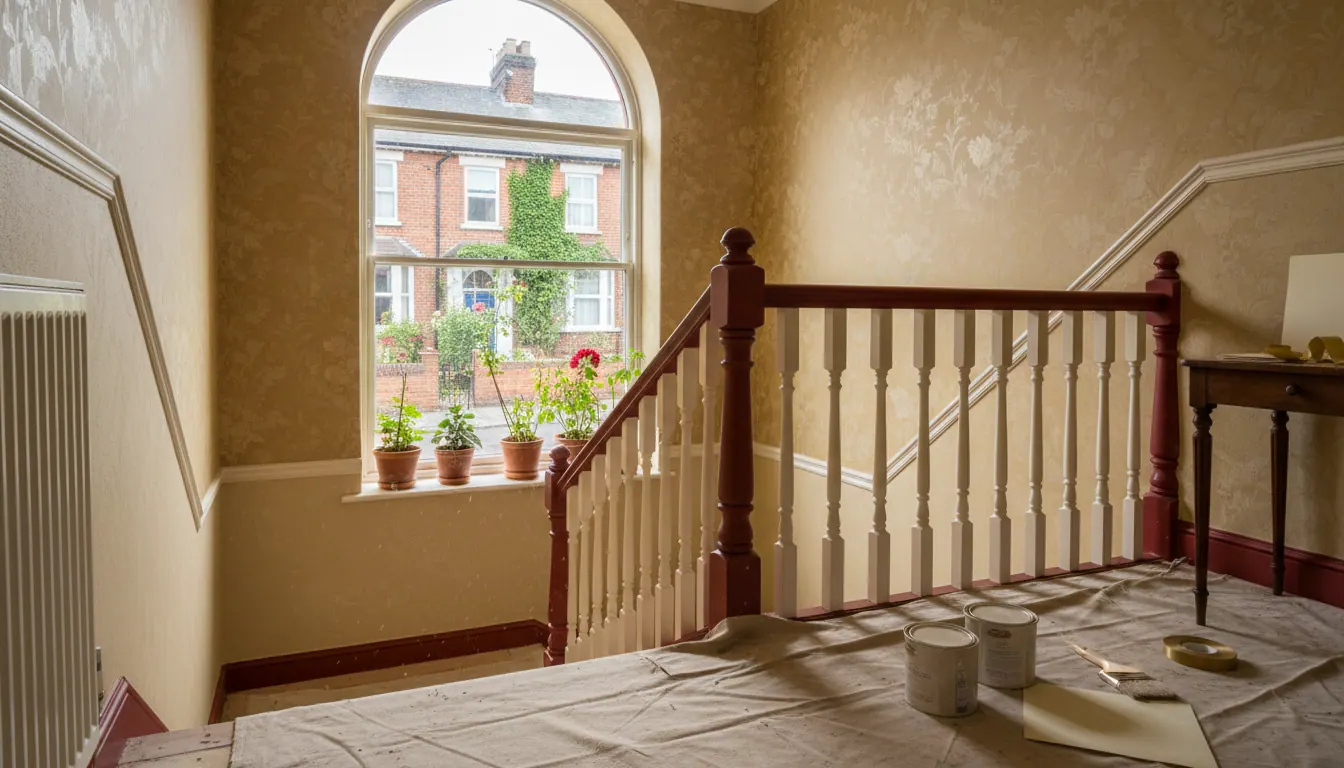
A staircase isn't just one surface. It's a collection of different materials and profiles all in one tight, awkward space. You have:
- Walls and ceilings along the stairwell, often with a high rake that's difficult to reach
- Spindles and balusters, which need individual attention and a paint that will hold up to daily contact
- The handrail, which takes more wear than almost any other surface in the house
- Newel posts at the base and top of the stairs
- Skirting boards and string (the angled board running along the side of the staircase)
- Risers and treads, if you're painting the stair structure itself
Each of these surfaces may need a different approach. Walls take a flat or matt emulsion. Woodwork needs a harder-wearing finish that resists knocks, grease and everyday handling. Spindles, because of their shape, require patience and the right technique to avoid drips and missed patches.
This is why staircase painting interior work benefits so much from a professional decorator. It isn't just about the painting itself. It's about understanding which products suit which surface, and how to work safely and efficiently in a confined, multi-level space without disrupting the household for longer than necessary.
Preparation: Where the Quality Is Decided
We've said it before and we'll keep saying it: preparation decides the finish. Nowhere is this truer than on a staircase.
Woodwork that hasn't been properly cleaned, sanded and primed will show every imperfection once the topcoat goes on. Old paint that's peeling or flaking needs to come back to a sound surface before anything new goes over it. Gaps between skirting and wall, or where spindles meet the handrail, should be filled and allowed to cure fully before painting begins.
On high-traffic woodwork like handrails and newel posts, we always make sure the surface is properly keyed so the new finish bonds firmly. A topcoat applied over a surface that hasn't been prepared correctly will chip, peel and look tired within months. Do it right once and it lasts.
The walls in a stairwell often need more preparation than people expect too. There can be hairline cracks where the plaster has moved slightly, patches of discolouration, or old paint that's lost its key. We assess all of this before we start, so there are no surprises once the first coat goes on.
For a deeper look at how preparation affects the overall result across all interior surfaces, our article on Interior Painting and Decorating in Bishop's Stortford: Walls, Ceilings and Woodwork Explained covers the principles in detail.
Choosing Colours for Your Staircase Interior
This is where homeowners often feel stuck. The staircase runs through multiple floors and connects different rooms, so the colour needs to work as a thread through the whole house rather than just looking good in isolation.
A few approaches that work well:
Keep the walls neutral, make the woodwork count. A warm white or soft greige on the walls gives you flexibility and makes the space feel open. Painting the spindles, handrail and skirting in a strong contrasting colour, a deep navy, a soft sage, a warm charcoal, adds real character without overwhelming a narrow space.
Use the staircase to transition between floors. If your downstairs is painted in warmer tones and your upstairs is cooler, the staircase can bridge the two gradually. This takes some thought and ideally a conversation with someone who knows how colours behave in changing light.
Consider the light at different times of day. Stairwells are often poorly lit, especially in older properties across Hertfordshire and Essex. Cooler whites can look flat and grey in low natural light. Warmer tones tend to perform better. We're happy to advise on colour choices as part of any job.
Don't ignore the ceiling. The stairwell ceiling is often painted the same white as the rest of the house and forgotten about. Carrying the wall colour a little higher, or using a slightly deeper tone on the ceiling, can make the whole space feel more considered.
Painting Staircase Walls: Practical Considerations
Working on staircase walls is physically awkward. The rake of the ceiling changes as you go up, access is tight, and you can't simply set up a standard platform and work across the whole surface. Safe access is a real consideration, not just for the decorator but for keeping the household moving while work is underway.
We plan access carefully before we start, making sure we can reach every part of the stairwell without cutting corners on safety or quality. We also work around the household where possible, keeping the staircase accessible at the start and end of each day.
If you're also thinking about preparing your room before a decorator arrives, the staircase has its own specific considerations: clearing wall art, removing stair rods or carpet grippers if treads are being painted, and making sure the space is as clear as possible.
Spindles and Handrails: Getting the Detail Right
Spindles are the part of a staircase that most people find daunting to paint themselves. There are a lot of them, they're fiddly, and getting an even coat on turned or decorative profiles without drips takes real technique.
We take our time on spindles. Rushing this part is how you end up with runs, missed patches and a finish that looks worse than what you started with. The right brush, the right product consistency and a methodical approach make all the difference.
Handrails are a different challenge. They need a finish that's genuinely hard-wearing because hands are on them constantly. We use appropriate products for high-contact woodwork and make sure the surface is properly prepared first. A handrail that looks good on day one but chips within a month isn't a good job, and a good job is the only kind we do.
Modern Staircase Painting Ideas: What's Working Well Right Now
We see a lot of staircases across Bishop's Stortford, Harlow, Great Dunmow and the surrounding villages, and certain approaches come up again and again because they simply work.
- Two-tone woodwork: painting the spindles one colour and the handrail and newel posts a slightly different tone adds depth without complexity.
- Bold wall colour in the stairwell: because the staircase is a transitional space rather than somewhere you sit and stare at the walls for hours, it can carry a stronger colour than a living room might.
- Painted stair risers: if the treads are carpeted or left natural, painting just the risers in a contrasting colour adds a graphic, modern detail with relatively little effort.
- Consistent skirting colour throughout: running the same skirting colour from the hallway, up the staircase and onto the landing creates a visual thread that makes the whole ground floor and first floor feel more connected.
Frequently Asked Questions
What's the difference between painting staircase walls and painting the woodwork? They're treated as separate tasks because they use different products and require different preparation. Walls typically take an emulsion finish, while spindles, handrails, skirting and newel posts need a harder-wearing paint formulated for woodwork. Getting the two to look clean and sharp where they meet is one of the details that separates a professional finish from a DIY one.
Should I paint stair treads and risers, or is that just for certain types of staircase? Painting treads and risers works well on solid timber staircases. If your stairs are currently carpeted, the treads are often in reasonable condition underneath and paint well once properly prepared and primed. It's a popular choice in older Hertfordshire properties where the original timber staircase is still intact. We'd always assess the condition of the timber first before recommending this approach.
How do I choose a colour for my staircase when it connects several different rooms? The key is to think of the staircase as a corridor that links spaces rather than a room in its own right. Neutral wall tones tend to work across the widest range of adjacent rooms, while the woodwork colour is where you can add personality. We're happy to talk through colour options when we come to look at the job.
Can you paint just the woodwork on a staircase, or does it have to be the whole thing? Absolutely, you can. If the walls are in good condition and just the spindles, handrail and skirting need refreshing, we can work on the woodwork alone. Equally, if it's just the walls and ceiling of the stairwell that need attention, that's a straightforward job too. We tailor every visit to what the property actually needs.
Ready to Transform Your Staircase?
A freshly painted staircase changes the feel of a home from the moment you open the front door. We're a family-run business with over 20 years of experience, working across Bishop's Stortford, Sawbridgeworth, Harlow, Stansted Mountfitchet, Much Hadham, Great Dunmow and Takeley. We take pride in our work and our well-earned reputation, and we'd be glad to come and take a look at what your staircase needs.
Call us on 07443 679900 to have a chat or arrange a visit. You can also send photos through our contact form if you'd like to give us an idea of the job before we come out.